
Fatal Faux Pas
How Trump's abrasive rhetoric may have permanently ruined our relationship with Canada.

Canada and America have a complicated relationship, in that there is no denying. Both countries comprise the two pieces of what was British North America. In this way, the US and Canada can be compared to Ulster and Ireland, or Pakistan and India. But there’s one difference between these two comparisons that is glaringly obvious. America and Canada have had peaceful relationships with each other for over 200 years now. But as of late, the fiery rhetoric of Donald Trump has put that relationship in peril. In this article, we will discuss the history, current state, and future of US-Canadian relations and what we can do to fix what Trump has done.
First of all, I give a little disclosure on my personal beliefs. I am a proud American nationalist. In that, I believe that one of the few intelligent things Marx ever said was that Canada is a principal part of these United States. But I do not support annexation. I support reunification. Annexation implies a hostile and one-sided takeover. We tried this in 1812, and it went poorly. (I could go on a whole tirade about how the performance of the American military in the War of 1812 was a national disgrace, but that’s a story for another time.) Canada will not be brought into the union with violence. To suggest such is an insult to the Canadian people. I believe Canada and the US should come together as one in mutual agreement and unification.
To begin our story, let’s talk about why Canada was separate from the US in the first place. It starts with how each nation was initially established. For the US, our beginnings were in Virginia and Massachusetts. These colonies, while being settled by vastly different peoples and for vastly different reasons, shared a common agrarian economic model. Having land suitable for farming meant that the colonies were more self-sufficient and could grow and develop on their own. In contrast, Canada finds its origins split between French and British fur trading colonies. That being Quebec and the Hudson Bay Company, respectively. While lucrative, these colonies didn’t have as suitable climates for agriculture and as a result remained small and dependent on importing goods from the home countries. So while the 13 colonies of America grew in size, wealth, and population, Canada was stunted. Its growth hindered by climate and lack of investment. But not for long, as control by both the French and British expanded, influence and settlement spread into the much more fertile Great Lakes and Ohio River Valley. Setting up the French-Indian War (7 Years War for my readers in the old world).
Now, at the time the French-Indian War began, what would now be considered the American Midwest would have been considered a principal part of Canada. As strange as it sounds, this is because the Great Lakes were part of the St. Lawrence watershed and were claimed as part of New France. So, they would have been considered legally part of the Quebec colony. But, as British settlers pushed further into Appalachia, they would cross the continental divide into the Ohio River Valley. Seeking further expansion west and more lands to farm, the colonists would grow more hostile to French forces in the region. Tensions between British-aligned and French-aligned native tribes would also drive this. Each seeking support from their own perspective European powers to tip the balance of power in their favor. This would eventually result in war when a force from the Virginia militia, led by a young George Washington, would accidentally fire on a French diplomatic party due to being intentionally deceived by their native allies. This would be the flashpoint that starts the war.
After 7 long years of war, both in the New World and on the European mainland, the British and their allies would come out on top. France would lose all its territorial claims in North America, choosing to keep its more lucrative sugar colonies in the Caribbean. Britain would have an open path for settlement all the way to the Mississippi if it chose, and the colonies were looking forward to pushing even further west. But the British were saddled with a problem: how to rule the people already living there. Firstly, you had the French-Catholic population of Quebec and the Maritimes that feared being oppressed and displaced by the puritanical protestants of New England. During the war, the French settlers of Acadia would be displaced and replaced by British settlers. Turning the territory into modern-day Nova Scotia. Second, after the French, were the former French-aligned native tribes that represented a massive block west of the Appalachians. These tribes would go to war if settlement encroached on their lands, representing a chronic issue for the British. So the British granted concessions, banning settlement west of the Appalachian Mountains and permitting Quebec self-government. To do this, however, they had to break promises to the 13 colonies. These policies, along with taxes levied against the colonies to pay for the war debts, would become known forever in the American consciousness as the Intolerable Acts.
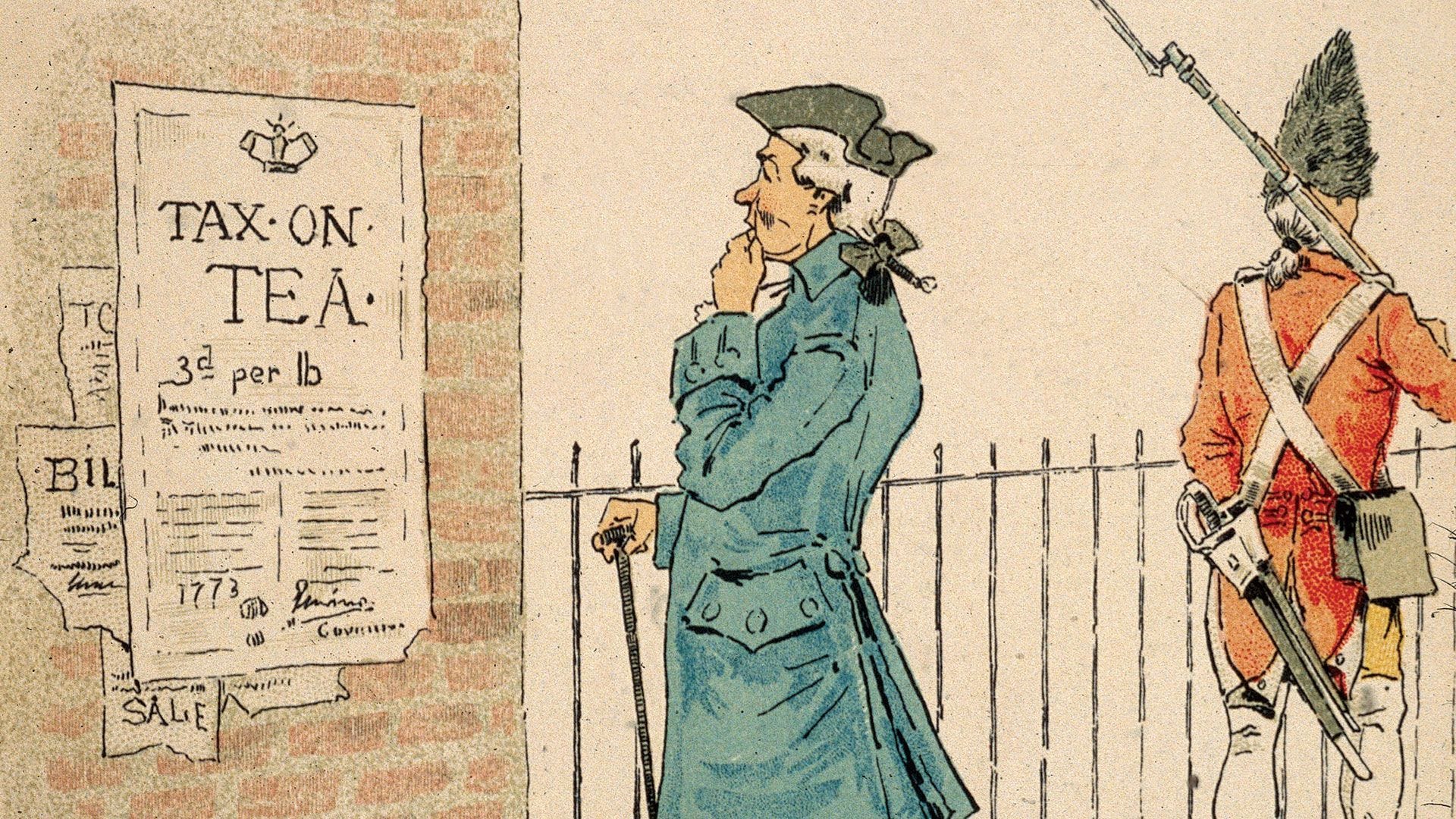
The Intolerable Acts are a point of debate among historians even to this day. That being whether or not they represent a just cause for the rebellion that would eventually make America independent. On paper, they do not seem overly harsh. But in reality, leading up to the war, they were devastating. Firstly, much of the colonies’ growth was based on cheap land. Cheap land attracted new settlers, who in turn developed the land. The land also represented a nest egg for settlers. When settlement attracted skilled labor, it drove the growth of towns. Towns would then buy the land from the first wave of settlers at significant markups. The profits allowed these first-generation farmers to diversify and create new business opportunities. Without more land to acquire, growth slowed, as land became prohibitively more expensive. Business ventures in the colonies also operated at very low profit margins. This was because of British mercantilist policies granting monopolies to companies such as the East India Company. Since they were the sole company the colonists could sell to, they couldn’t bargain for better prices. So, when tariffs were introduced, it forced businesses that were already struggling to make a profit into the red. The colonists would protest and demand representation in parliament so they could argue in their favor. This would fall on deaf ears and result instead in a crackdown on dissonance in the colonies. Then, in 1775, Massachusetts crossed the point of no return and entered open rebellion against the British. The rest would soon follow.
Now you must be asking, “If these conditions were so bad, why didn’t Canada join the rebellion?” Well, dear reader, there are three factors. First, fur trading was significantly more lucrative than much of the agricultural goods that were coming out of the colonies. This, coupled with the fact that these colonies were more dependent on imports, meant that from an economic standpoint, the Canadian colonies were simply less affected by the tariffs. Second is geographical, if you look at a map, Canada is much closer to Britain than America is, its higher latitude meant that British forces could arrive in Canada weeks sooner than they could in Boston or New York City. Third and finally, the demographics.
Firstly, despite the alliance with France, the Quebecois were unlikely to join on the side of the Americans because they knew they’d likely be displaced or overwhelmed if they did. Secondly, the overall population of Canada was extremely low in comparison. Estimated in 1775 to be around 100k. Compare that to the 2 million people living in the 13 colonies. This difference in population meant that Canada was underdeveloped and less capable of raising an armed rebellion, even if it wanted to. Demographics would become an even bigger factor once the war ended, and Canada would be flooded with loyalist refugees. This would give a much-needed boost to the population, but it would be one that was uniquely anti-American. Many of these loyalists would settle in what would eventually become Ontario province, creating the agricultural base Canada would desperately need. Even then, Canada would always lag severely behind the US in population growth. Even by the War of 1812, the disparity would be half a million Canadians to almost 8 million Americans.
The War of 1812 would further drive divisions. Not only would it embolden loyalist and anti-American sentiments, but it would also force Britain to begin investing more in Canada. Before the war, British North America took a back seat after American Independence in favor of India, Australia, New Zealand, and South Africa. But the War of 1812 caused Britain to shift focus back to Canada for an entirely different reason: containment. In other words, Canada would be used as a buffer state to curtail the growth of the US. This would be no small feat. It would require Britain to do three things. Firstly, it would require Britain to encourage the growth of Canada without it becoming so big that it would seek independence itself. Secondly, it would require that Britain constantly appease the Quebecois, who were deemed the most likely to develop separatist sentiments. Third and final, Britain would have to help cultivate a national identity in Canada that would be openly oppositionist against America. With strong loyalist sentiments after 1814, this would be easy, but would such sentiments stay strong as time passed?
We see this strategy reflected in Canadian politics to this day. A heavy emphasis is placed on appeasing and subsidizing Quebec while maintaining a political culture that seemingly goes out of its way to be contrarian to the US. But problems with this strategy would emerge almost immediately. While Britain could influence the political culture to be anti-American, it couldn’t influence Canadian culture itself. This was especially the case in the western reaches of Canada, where the territories were often settled by the same waves of migrants who settled America’s Pacific Northwest. The second part was that while Britain could deter American military power, the economic power of the US would not be deterred. As America grew and industrialized, its population and economic capacity would eventually even dwarf its former colonial overlord.
Being its direct next-door neighbor, the US inevitably became a more profitable trade partner than Britain. The British would then have to ensure that economic relations with Britain would always be preferred over relations with America. It could do this so long as there was an empire to provide Canada with a global market to buy Canadian goods. Alas, with the conclusion of WW2, the British Empire was all but undone, and with it, the status quo over Canada. The decline of the British Empire resulted in a period of economic stagnation in Canada. Their economic policies still reflected those during the imperial period. Meaning Canada still had harsh protectionist policies against the US. Canada wasn’t willing to open its doors to American investment and commerce, but America was, and that would prove to be an increasingly irresistible offer.
America would end up giving very generous offers to the Canadian people and expecting little in return. In this, Donald Trump is right. But what Trump doesn’t understand as a businessman (he can only comprehend the bottom line, not those factors that aren’t on the books) is how America trades those profit losses for soft power. In 2024, Canada sold 3 quarters of their exports to the USA. In this, we see the real genius of US policy; we don’t have a deficit. Much like the British, we are paying for a monopoly on the Canadian market and the soft power that comes with it. You see, America benefited from the status quo with Britain as much as they did. Because, as long as Britain ruled Canada, more expansionist powers didn’t. Canada is as much a buffer state for us as it was for Britain. Canada has the only land border that the US has that would be suitable for conducting an invasion. Mexico’s border is far too rugged. Therefore, Canada is the soft underbelly of Fortress America.
So for the longest time, a free and independent Canada was just as good for the US as it was for Britain. During the Cold War, Canada became a buffer state between America and the Soviet Union, even when Canada disagreed with American policy. You see, Canada being better liked than America benefits Americans immensely. Since the easiest way to attack America is through Canada, and America and Canada are on the same team, one must attack Canada to get to America. But attacking Canada, which has exceptional diplomatic relations throughout the world, would be to incur global condemnation and ire. But this model only works if Canada remains stable and strong, which it increasingly isn’t.
Decades of economic mismanagement have led to a rise in separatist sentiments, recession, and stagnation in Canada. While Quebecois separatism is the its lowest in decades, new movements are rising in the far more profitable western provinces. At the same time, growing dissatisfaction with the government in Ottawa means the internal stability of Canada is shaky at best. And at this moment, at this crucial time, where America needs to be there as the big brother, the shoulder Canada can lean on, Trump opened his big, fat mouth. Trump’s incendiary remarks destroyed Canadian trust in America and delivered the Liberal Party another victory. Not only that, it destroyed America’s soft power control over Canada. So now Canada is unstable, increasingly insolvent, and vulnerable to foreign influence. With large swaths of the country owned by Chinese businesses, it is likely the red giant might make a play to threaten American interests on their own continent.
Let it be known, America means Canada no harm, but if Canada becomes a danger to American security interests, we will take action. The greatest example of this historically was War Plan Red. During WW2, America created a plan to occupy Canada in the event Britain fell to the Nazis. The goal of this is obvious; it’d deny the Nazis’ ability to exert influence in Canada and possibly use it as a staging ground to invade the USA. If Canada were to fragment or become threatened for any reason, it is in the interests of the United States to annex or occupy Canada outright to ensure our own safety. It’s not desirable by any metric. We’d love to live in peace and harmony with our brothers in the north, but if necessary, it must be done. But if at all possible, a peaceful solution must be found. The unity and coexistence between Canadians and Americans must be maintained. The unity and brotherhood of all Anglo-Americans is far too precious for it to be lost to a businessman’s ego. Maybe some day Canada and America will become one peacefully, and an opportunity might come about soon if the western provinces push for closer relations with America. But if Canada breaks apart, our hand will be forced, and it will break our hearts to do what must be done.