
Power For The People
A case for nationalizing the electricity industry.

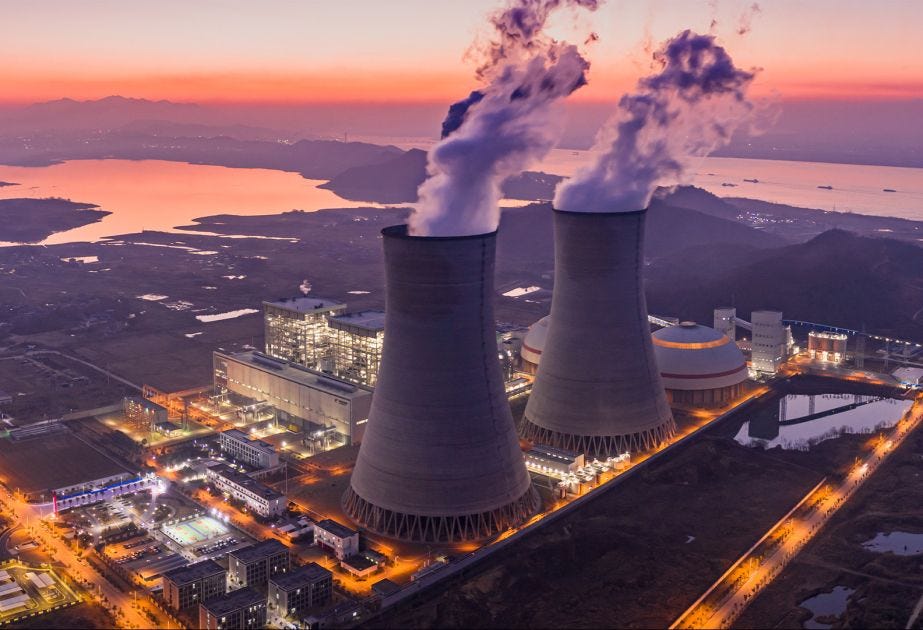
At the center of all modern economies is energy. The production, the distribution, and the usage of energy are the most important things fundamentally in every economy. But the way we deal with the generation and distribution of energy in the US is fundamentally backwards to keeping us ahead of our rivals and competitors. As we speak, the biggest producer and innovator in electrical power generation is not the USA, it is China. In this essay, I will explain what we do wrong and how to fix it.
The first major thing we do wrong is how we view electricity. We treat electricity as a commodity. That being, we treat it as something that is supposed to be sold or traded for profit. But electricity, or energy in general for that matter, should not be treated as a commodity. Because what it is, in fact, is a resource. Now, what is the difference between a resource and a commodity, you might ask? A commodity is a good that exists specifically to be traded for a profit. Trading the commodity is an end in itself. A resource is something essential to production. Since it is essential to production, the sale of a resource isn’t the end. The end of a resource is its use to create new commodities. So the main fundamental difference is that the purpose of a resource isn’t derived from its ability to be sold for profit, but its necessity to drive production.
With this in mind, the issue with why America is falling behind in the generation of power and the development of infrastructure. We are operating on a for-profit model of electrical generation. Under this model, the companies prioritize cheap infrastructure and fuel in order to ensure profits. But, as I said, electricity is a resource, not a commodity. So we should not be prioritizing the profitability of electricity, but the maximization of its output. This cannot exist in our current model because the power companies owe a fiduciary duty to their investors to make money. Critics of my policy would say that overregulation is responsible for getting in the way of using better sources of electricity such as nuclear, but deregulation won’t go that far. Why? Because electrical companies are natural monopolies.
In order to understand this, we must diverge from economics to physics. As many of you know, electricity is the flow of electrons on the atomic level. What you probably don’t know is that at this level, the laws of thermodynamics are still well in effect. Yes, dear reader, even at such a small scale, friction is still a factor. What this means is that there is actually a maximum distance from the generation source you can be before that source can no longer provide adequate energy supplies. As a result, power plants and the companies that own them are geographically locked. Given that power companies are also usually the owners of and responsible for building and maintaining the infrastructure means that every power company in the US is a regional monopoly that has no real competition. Even if you choose a different company to be your generation source, you still have to pay your primary company because they own all the lines in your region. No amount of deregulation will make this market competitive because no amount of deregulation will overcome the geographic lock that power companies are in.
So, if power companies are natural monopolies, and there is nothing we can do to stop those monopolies, then those monopolies should not be for profit. In short, the essentialness of the industry mixed with the lack of competition means that the industry should not be in private hands. As if it remains in private hands means that the industry will never reach its full potential. Instead, all infrastructure and power plants should be consolidated into one state-owned power company with the goal of maximizing efficiency and output of electricity to the public. Removing the profit incentive allows us to take more costly risks with developing new technology. It would also allow us to create more advanced power plants without worrying about the cost of safety and environmental equipment.
But what about the taxpayer, you are probably wondering. Wouldn’t that leave the burden on the taxpayer to cover the losses? Yes, but consider the following. If we drive the cost of energy to a rock-bottom price, everything that requires electricity to run or be produced will also decrease in cost. Goods and services will get cheaper as a result, which in turn drives down the cost of living. This means people have more savings they can use to buy more goods and services, or invest in starting a business. All of this increases economic activity and output, which in turn increases tax revenue. As long as the total economic utility is greater than the deficit to run the power plants, it isn’t a loss to produce electricity at less than profitable margins.
In conclusion, the power industry is incapable of reaching its full potential as for-profit companies. They can only truly achieve their full usefulness under the ownership of the general public. This way, electricity generation can be maximized for the sake of maximizing the economic utility of our power output and grid. As long as the total economic boom as a result outweighs the deficit, it is perfectly acceptable to produce this electricity at a loss because the money will be made up for with the net economic gain created by the cheap electricity. We must nationalize power; we will never be able to achieve our true economic potential until we do so. Until next time, dear reader.